The Definition of Time
t = ⟨u|φ⟩ — a projection, not a parameter · Status: Derived
The Definition
In standard physics, time is a background parameter — a coordinate on which events are located. Newton treats it as absolute. Einstein treats it as relative to frame. Neither asks what it actually is. MPRC answers that question directly.
| |φ⟩ | Future — probability cloud, outer ring position, uncommitted. The ket without a bra is mathematically incomplete. That incompleteness is the future: real but unresolved. |
| ⟨u| | Present — the observer enters the frame, Least Action about to happen. The bra without a ket is also incomplete. The observer without a frame has no Least Action to perform. |
| ⟨u|φ⟩ | Past — the projection. A scalar. Finished. This is what the mathematics produces when bra meets ket: Newton's a→b and Einstein's relative-to-observer reading, unified. |
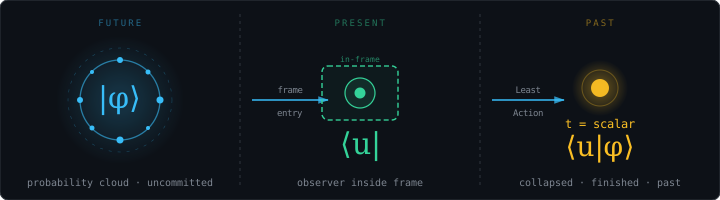
The notation is not decorative. Each symbol earns its place. The structure of the bra-ket formalism already contained the physics of time before it was interpreted this way. MPRC reads what was already written.
Physical Grounding
The Extension of Einstein
Einstein showed that two observers at different reference frames measure different scalars for the same event. A lightning bolt is simultaneous for the platform observer and sequential for the train passenger. The event is identical. The scalar differs.
Einstein explained that frames produce different scalars. He did not explain why. MPRC provides that answer: Least Action is an in-frame operation. The scalar you read depends on whether you were inside the frame when it was generated.
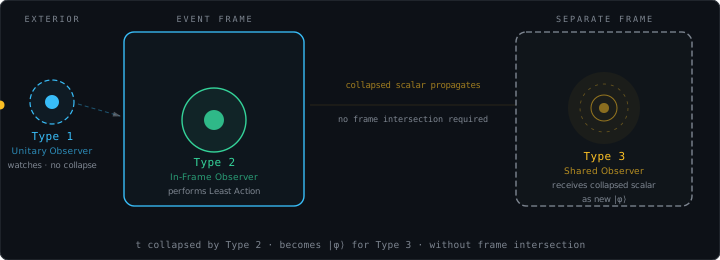
One actor performed Least Action. Multiple observers read the collapsed scalar. Observation and Least Action are not the same thing. QM conflates them. MPRC separates them.
Observation — reading a collapsed scalar. Available to any frame-exterior entity.
Least Action — the act that produces the collapse. Only available to the in-frame observer.
The Propagation of Collapsed Scalars
A person commuting in Lahore uses fuel. A person sleeping in New York wakes to a higher fuel price. They never met. They share no frame. The collapsed scalar from one observer's Least Action propagated and became the probability cloud — the |φ⟩ — of an observer in a completely different frame.
This is the Shared Observer formally justified. Biology calls the same phenomenon herd immunity. Physics had no name for it because it had no frame theory that allowed collapsed scalars to propagate across non-intersecting frames. MPRC does.
Three Observer Hierarchy
The Geometric Codec
φ is not a metaphor for time. It is clock time expressed in ring coordinates, connected by an exact invertible geometric constant derived from the ring structure itself.
The constant 16/45 is not fitted or imported. It is the ratio of two geometric quantities: the QH4 ring has 256 states. The u-spinor completes one full cycle in 720°. Therefore:
The ancient sexagesimal time system (base 60, 24-hour day, 60-minute hour, 60-second minute) was not arbitrary. It was the subdivision of 720. The spinor generates all time units and the seconds return to it exactly:
Vacuum Node Verification
| h (hours) | g(h) = (16/45) × h | φ node | Status |
|---|---|---|---|
| 0 | 16/45 × 0 | 0 | ✓ Exact integer |
| 180 | 16/45 × 180 | 64 | ✓ Exact integer |
| 360 | 16/45 × 360 | 128 | ✓ Exact integer |
| 540 | 16/45 × 540 | 192 | ✓ Exact integer |
| 720 | 16/45 × 720 | 256 ≡ 0 | ✓ Ring closure |
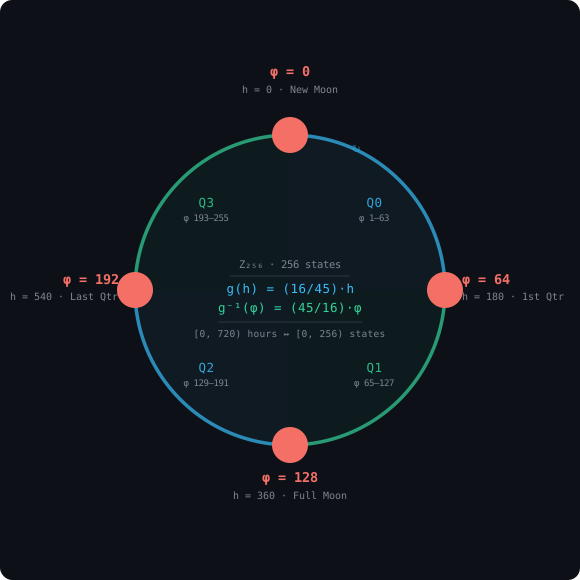
All four vacuum nodes {0, 64, 128, 192} are exact integers. No approximation. No remainder. The ring and the clock are commensurate — demanded by the geometry, not enforced by fitting.
Kinematic Verification
The Chain — Newton → Einstein → MPRC
Each framework extends the previous without contradiction. Each one says out loud what the previous left hanging.
Einstein reduces exactly to MPRC inside a single frame. Newton reduces exactly to MPRC at low velocity in a single frame. No contradiction at any level. Each is a special case of the next.
Status — Derived, Verified, Open
| Claim | Status |
|---|---|
| t = ⟨u|φ⟩ as the definition of time | Derived |
| Three-observer hierarchy | Derived |
| 16/45 codec exact and invertible | Verified — 4/4 vacuum nodes, kinematic check |
| Newton as limit | Derived |
| Einstein's proper time (gravitational) — GPS | Verified |
| Einstein's proper time (velocity) — muon case | Open |
| φ passes through zero at vacuums (does not stop) | Derived — oloid + gyroscope angular momentum |
The observations were always there. The mathematics was always there. The interpretations were all circling the same structure in different languages. t = ⟨u|φ⟩ completes the sentence they were all building toward.